

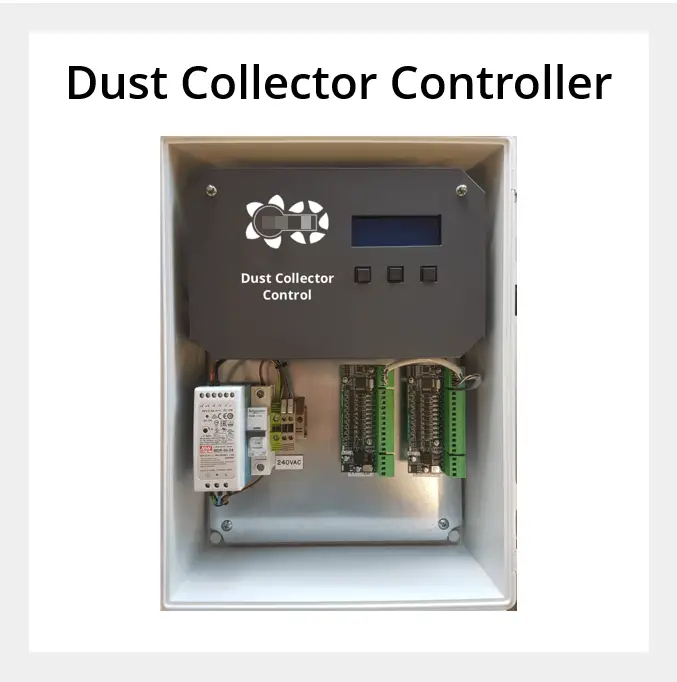
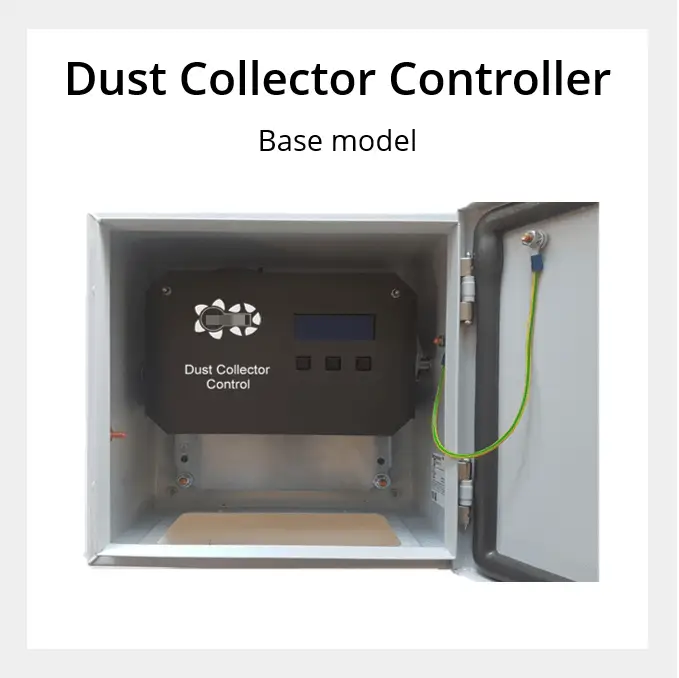

Dust Collector Controller uses demand based monitoring to pulse the bags only when cleaning is needed. Pulse control can save you up to 50% of the compressed air being used and increase filter life by up to 30%.
Inbuilt sensors measure the performance of a dust collection installation then manage the number of pulse cleaning cycles.
The controller is can be retro-fitted to existing dust collectors in less than one hour and the savings start immediately.
Options:
- Voltage: 24vDC or 100-240vAC
- Extension cards (10 pulse valves per card)
Dust collector controller uses demand based monitoring to pulse the bags only when cleaning is needed. The pulse control differs to standard industrial dust collectors which use time based controls and significant amounts of compressed air to clean the collector bags. Pulse control can save you up to 50% of the compressed air being used and increase filter life by up to 30%.
This dust collector differential pressure controller optimises baghouse productivity. Inbuilt sensors measure the performance of a dust collection installation then manage the number of pulse cleaning cycles.
The controller is can be retro-fitted to existing dust collectors in less than one hour and the savings start immediately.
Key Features of the Dust Collector Controller
-
On demand differential pressure cleaning of dust collectors
-
Reduces dust collector compressed air use between 10-50%
-
Metal Enclosure
-
Differential pressure monitoring with tube clearing function
-
Basic unit has 10 valves with extensions available for up to 60 valves
-
Adjustable pressure levels
-
Adjustable pulse duration
-
Maintenance mode for pulse valve fault diagnosis
-
Two voltage options:
-
24vDC or
-
100-240vAC
-
-
Outputs:
-
Alarm Relay and
-
4-20mA for differential pressure
-
-
Four Alarms:
-
Solenoid Failure,
-
Differential Pressure,
-
Low pressure and
-
Broken bag detection (with optional dust sensor)
-
Dust Collector Controller Options
- Two voltage options: 24vDC or 100-240vAC
- Extension cards: up to 10 valves, 20 valves, 30 valves, 40 valves, 50 valves or 60 valves
Other Information
Part Numbers: DCC100010, DCC100020, DCC100030, DCC100040, DCC100050, DCC100060, DCC200010, DCC200020, DCC200030, DCC200040, DCC200050, DCC200060
Specifications
General
Application |
Measure the performance of a dust collection installation and manage the number of pulse cleaning cycles required to optimise productivity. |
Display |
LCD Display |
Valve sequencing |
|
Mode of Operation |
|
Fault Diagnostics |
|
Power
Power supply |
|
Voltages |
AC In / DC Out
DC In / DC Out
AC In / AC Out
|
Timer Operation
Number of valves |
Up to 60 valves |
ON Time |
50 – 999 milliseconds (ms) |
OFF Time |
1 – 999 seconds (s) |
OFF Time 2 (fast) |
1 – 999 seconds (s) |
Pulsing mode |
Sequential or Arbitrary (user defined) |
Clean after shutdown |
1 – 255 cycles |
Autocycle Forced Pulsing |
1 – 24 hours |
On Demand Cleaning
Differential Pressure |
KPa, mm H2O or inWG |
Ultra low level |
Unit in Standby |
Low level |
Pulsing stops |
High level 1 |
Pulsing starts |
High level 2 |
Pulsing faster |
Alarm level |
|
Tube Cleaner |
Duration (s) and interval (mins) |
Input
Input sensors |
|
Input Sensor Types |
4 input sensors
|
Output
Solenoid valves |
|
System active relay |
Dry contact (NO/NC) |
Three (3) configurable alarms |
Dry contact (NO/NC) |
Differential pressure |
4-20mA |
Output relays |
|
Communication
Transmission mode |
RS485 port |
RS485 link |
2 wire (master and slave comms) |
Coms protocol |
MODBUS RTU |
Other Information
Casing |
Metal Enclosure |
Installation Type |
Permanent installation |
Warranty Period |
12 months |
About Dust Collector Controllers
Where most baghouse dust collectors rely on continuous pulse cleaning processes to maintain plant efficiency provides an inbuilt differential pressure sensor to accurately measure the performance of a dust collection installation, and based on those measurements, manage the number of pulse cleaning cycles required to optimise baghouse productivity.
Pulse control can save you up to 50% of the compressed air being used and increased filter life of up to 30%.
This dust collector differential pressure controller optimises baghouse productivity. Inbuilt sensors measure the performance of a dust collection installation then manage the number of pulse cleaning cycles.
The controller is can be retro-fitted to existing dust collectors in less than one hour and the savings start immediately.
Selecting the right controller
When selecting the correct dust collector controller, match the:
- available input power type and voltage (240VAC or 24VDC for example), and
- ratings of the solenoid valves (240VAC or 24VDC for example).
Selecting the wrong controller or solenoid valves will result in damage to the equipment.
Why should you optimise baghouse productivity?
Optimising baghouse productivity can power can:
- result in fewer cleaning cycles
- reduce maintenance hours
- use up to 50% less compressed air
- extend filter life
- reduce energy costs
- reduce carbon emissions
Key Features of the controller
- On demand differential pressure cleaning of dust collectors
- Reduce dust collector compressed air use between 10-50%
- Metal Enclosure
- Differential pressure monitoring with tube clearing function
- Basic unit has 10 valves with extensions available for up to 60 valves
- Adjustable pressure levels
- Adjustable pulse duration
- Maintenance mode for pulse valve fault diagnosis
- Two voltage options
- 24vDC
- 100-240vAC
- Outputs
- Alarm Relay
- 4-20mA for differential pressure
- Alarms
- Solenoid Failure
- Differential Pressure
- Low pressure
- Broken bag detection (with optional dust sensor)
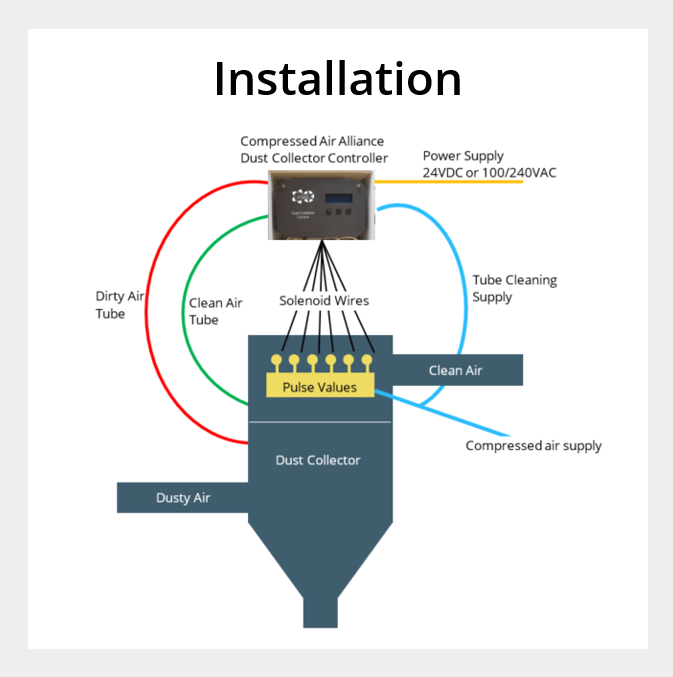
Installation Requirements
Installing dust collector controllers is not difficult but should be done by suitably qualified and experienced technicians. Some knowledge of MODBUS communications is required to connect the power meters to your network.

